
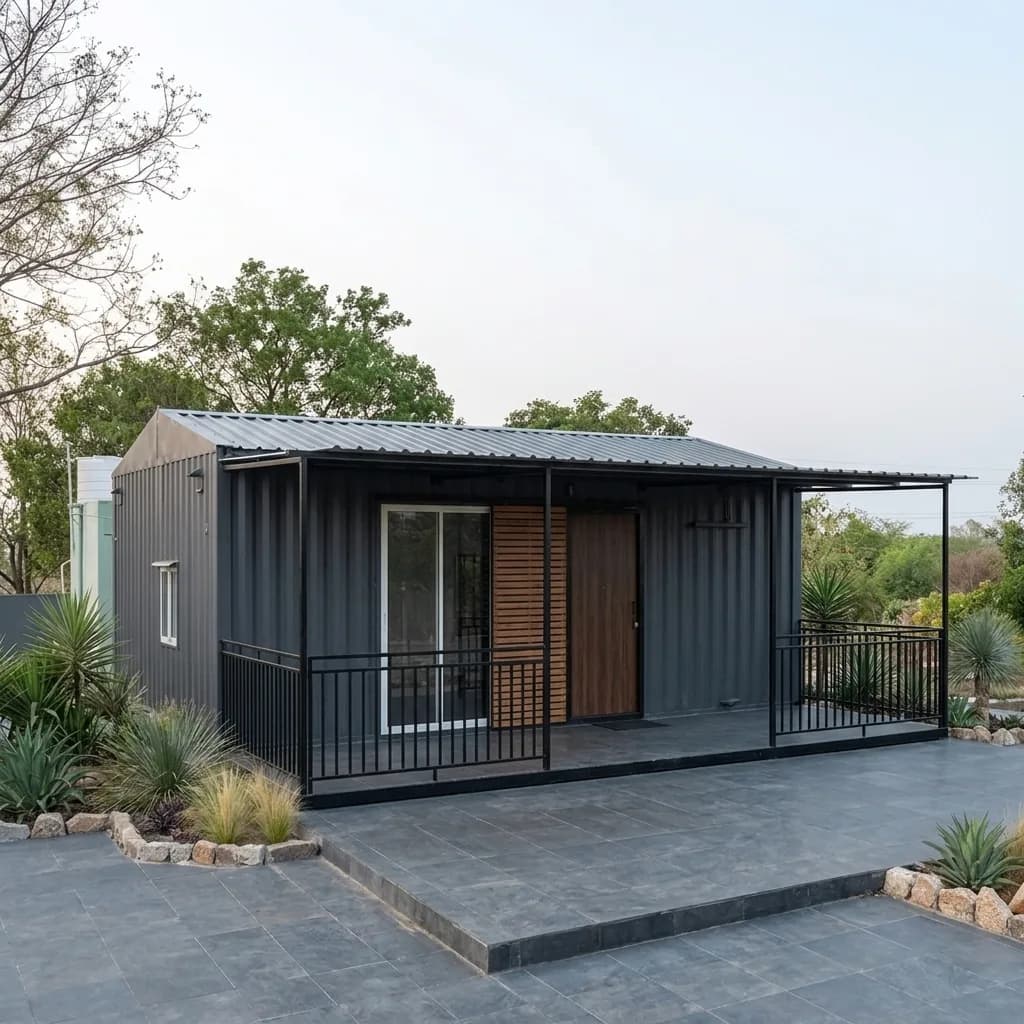
Portable Farmhouse Manufacturers in Coimbatore
Furniture, appliances, air-conditioning, decks and other accessories shown are optional. Final inclusions are as stated in the approved quotation.
PRIMARY PRODUCT IN COIMBATORE
Portable Farmhouse
A converted shipping container fitted out as a small house and delivered complete to farm land around Coimbatore. The layout is settled with you rather than picked from a catalogue. A studio as one open room with a bathroom and a kitchen counter; a one-bedroom with a separate living area; a two-bedroom where a family actually stays over; any of those with a covered verandah along the front, which on a farm is where the time actually gets spent. Two units placed alongside each other where a guest or caretaker unit is wanted, or a working unit — office, tool store, and a lockable room for pump and irrigation equipment — where what you need is not a house at all. Tell us how many people will stay, whether the kitchen is inside or separate, and which way the view is, and the layout follows from that.
AVAILABILITY
Available for sale
Available sizes
- Built from shipping container shells in fixed lengths, single or placed alongside each other, with the internal layout built around how you intend to use it.
Specifications
- The container shell and its condition, the insulation and internal lining, floor and ceiling finishes, openings, doors and windows, bathroom and kitchen fittings and the electrical scope are all finalised against the approved quotation and drawing.
Final specifications, sizes and pricing are as per the approved quotation. See the full product page for the complete specification.
Why Building Out There Is Harder Than It Looks
None of these is the reason people give at the start. They are the reasons the house is still not up. **You cannot supervise it.** You live in the city and work most of the week. A conventional build wants somebody on site most days, and when that person is not you, what gets built drifts from what was drawn in ways you find out about at the end. **The trades have to travel.** A mason or a carpenter coming out to a plot week after week is a different proposition from one working in town, and it shows up in what the job actually costs against what was quoted. **Material sits on open land.** Cement, steel, sanitary ware and fittings accumulate on a plot with no compound wall and nobody there at night. What that is worth risking is your judgement, not something we can put a number against. **The approach decides everything.** A plot reached by a track rather than a made-up road turns every delivery into a negotiation, and the monsoon settles the argument. **It happens in bursts.** Not because the work is hard, but because it fits into the gaps in the rest of your life. Building the unit away from the land removes the category rather than improving it. The work happens where the people and the tools already are, and your plot is involved on one day.
What a Portable Farmhouse Is
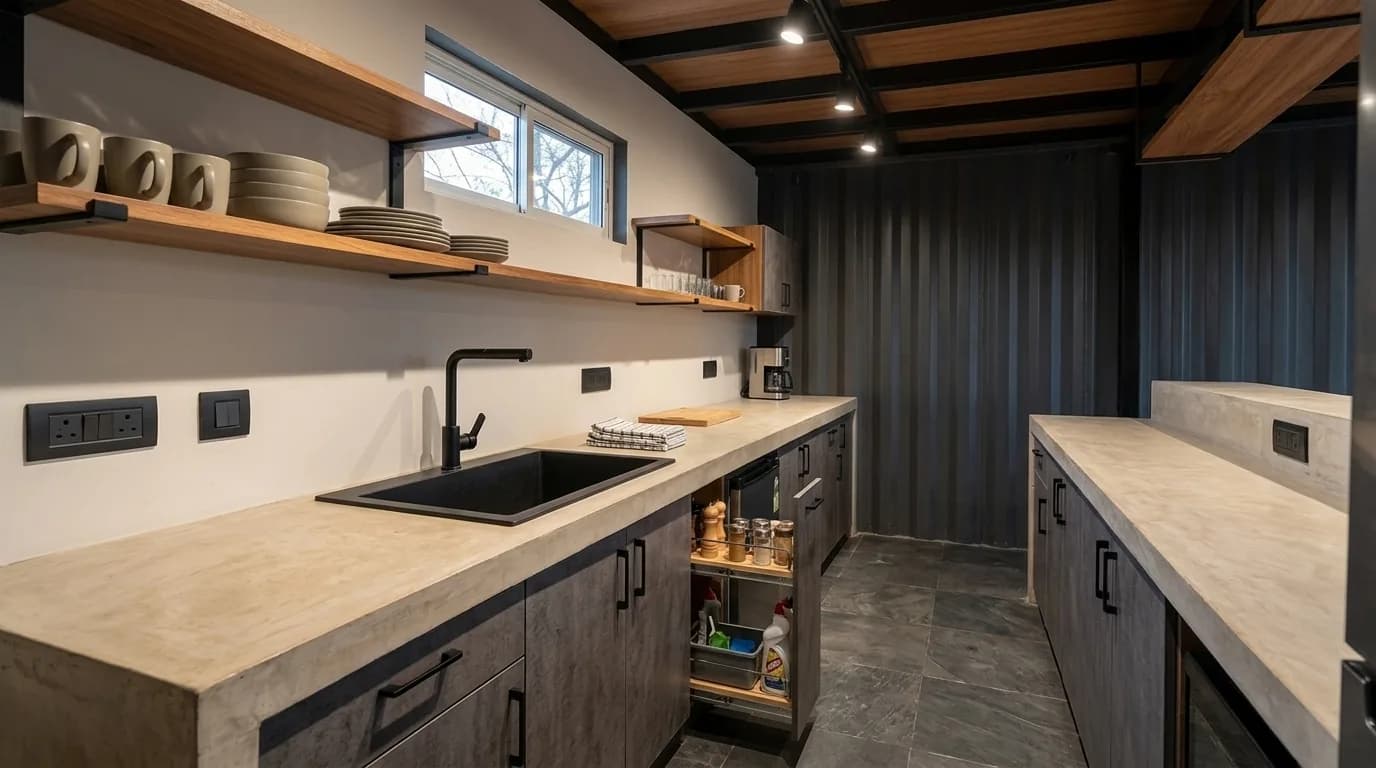
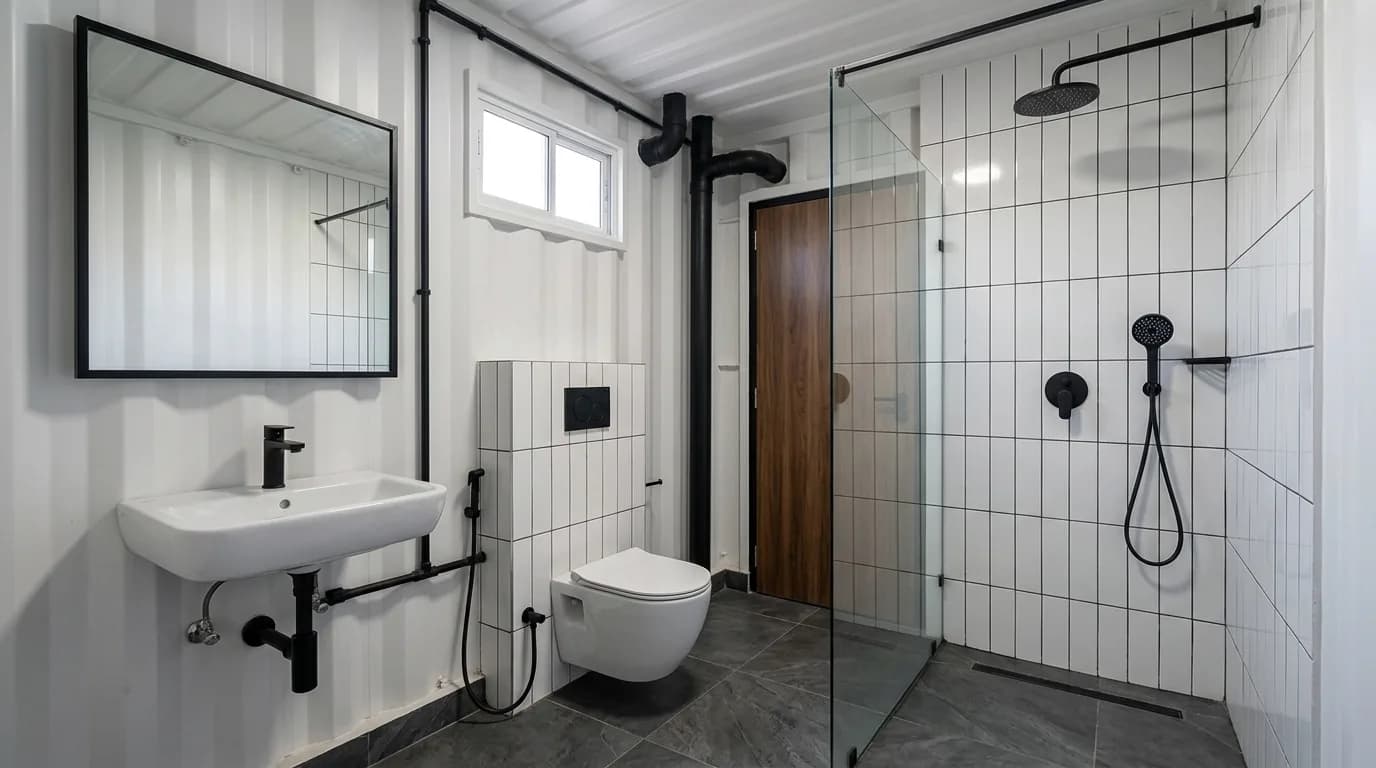
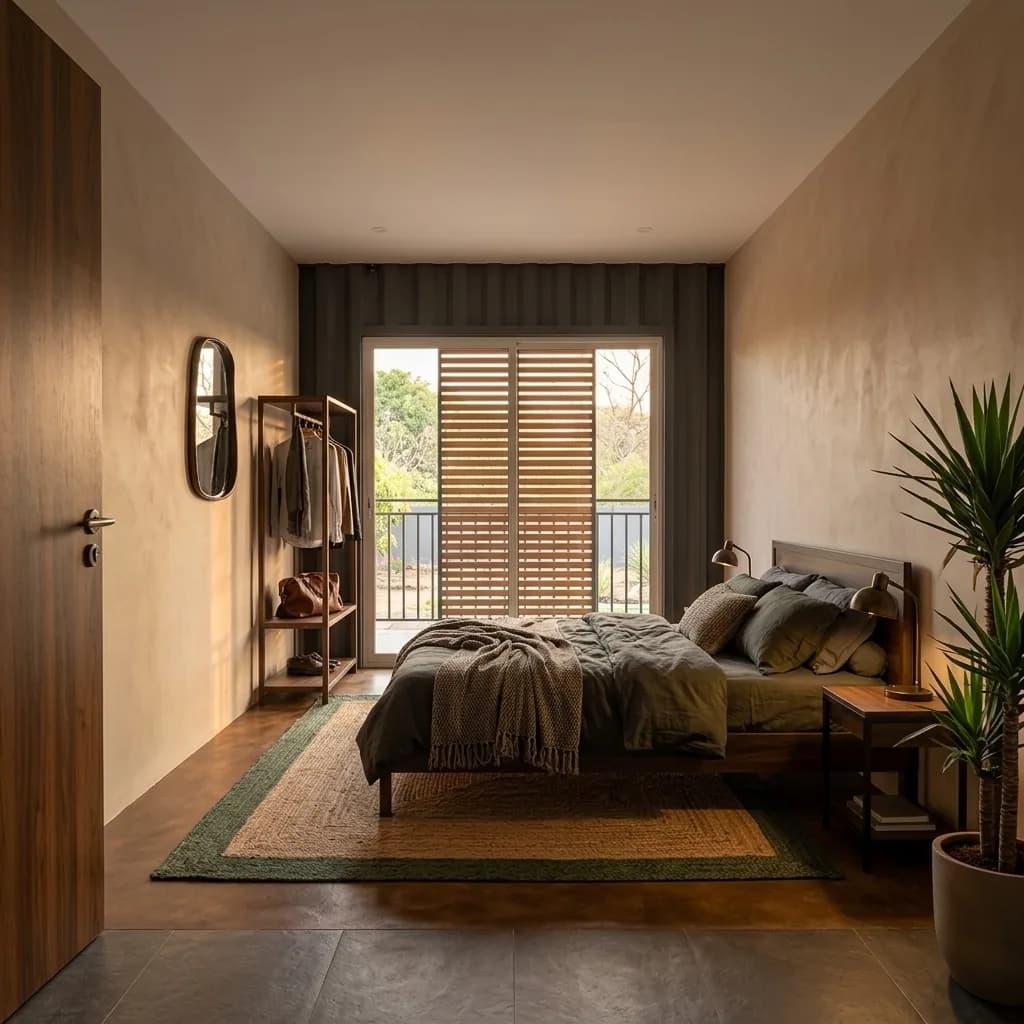
A converted shipping container fitted out as a small house. The shell is a steel container on its own frame; the fit-out is the part that turns it into a room — insulation and internal lining, a finished floor and ceiling, openings cut and framed for doors and windows, wiring, lights and points, a bathroom with fittings and a kitchen counter with a sink. All of it is done before the unit leaves our facility. It travels on a vehicle and is lifted into position by crane or hydra. Water and power are brought to connection points on the unit, and drainage outlets are brought to the outside of it. Because it sits on its own steel frame rather than being built into the ground, it can be lifted and repositioned later — moved to another corner of the land, or taken with you. **One honest limit.** This is a small house, and it is at its best between roughly one and three rooms. If what you want is four bedrooms and a double-height living room, that is a conventional build and we would rather say so now. The appeal here is that it exists at the end of a delivery rather than at the end of a project.
Living on a Plot With Nothing Connected
Farm land rarely arrives with services on it, and what is missing has to be designed for at drawing stage rather than discovered on the day the unit lands. Tell us what your plot already has and what it does not, and each of these is either built in or left out on purpose — and either way it is written into the quotation. **Power.** Solar and battery provision, or a generator inlet point, sized against a list of what you actually intend to run. Give us that list and the sizing is stated in the quotation rather than assumed. Where the plot already has a grid connection, standard wiring and none of this is needed. **Water.** A tank mounted on the structure or on a separate stand, plumbing run from it, and a connection point for a borewell pump or for tanker filling. **Drainage.** Bathroom and kitchen outlets are brought to the outside of the unit. The soak pit or septic arrangement is yours to build, and it needs to be settled before the unit is placed rather than after. **Heat.** Insulation and the way the unit is oriented are both decided at drawing stage. Which wall takes the afternoon sun, where the verandah faces and how the unit cross-ventilates cost nothing to get right on a drawing and a great deal to change afterwards. **Insects.** Mesh on openings, sealed joints and no gaps under doors, specified as part of the fit-out. **A building that stands empty.** Doors with proper locks, window grills, and shutters where you want them. A house nobody is in for five days a week needs to close up, and that belongs in the specification rather than being added later.
Read This Before You Order: Permissions
This is the part where we are going to be less helpful than you might want, and it is deliberate. What you are permitted to build, place or occupy on agricultural land depends on the classification of your land, where it is, the local authority, and what you intend to use it for. Those rules are not the same as for a residential plot, they are not the same everywhere, and they are not the same for a private weekend house as for something you intend to let out. We do not advise on any of it, and you should not take advice on it from a supplier. Speak to a local advocate or a consultant who handles land matters in your taluk before you place an order with us or with anyone else, and ask them about your specific survey number and what you intend to do there. What we will give you is the unit's dimensions, weight, construction details and the fact that it is a movable structure on a steel frame rather than a masonry building, so that your advisor has accurate information to work from. What we will not do is tell you it will be fine. **What to ask for in writing.** From us, and from anyone else you are comparing: the materials, what is included, what is excluded, and what the site has to provide. Those four things belong in the approved quotation, and a decision made against them is a decision you can hold someone to.
Designing Around Where Your Land Actually Sits
Land on the plains and land up in the foothills are different problems, and the difference is settled on a drawing rather than after delivery. On the plains the questions are sun and air: which way the long wall faces, where the verandah goes so it is not taking the worst of the afternoon, and how the unit cross-ventilates so it is not depending on equipment that may be running off a battery. In the foothills the questions are water and sealing: the roof overhang, how the panel and roof joints are sealed, and where water goes once it leaves the roof and reaches the ground around the base. Tell us roughly where the land is and which way it faces. It changes what we draw, and it costs nothing to settle at that stage.
Before the Vehicle Is Booked
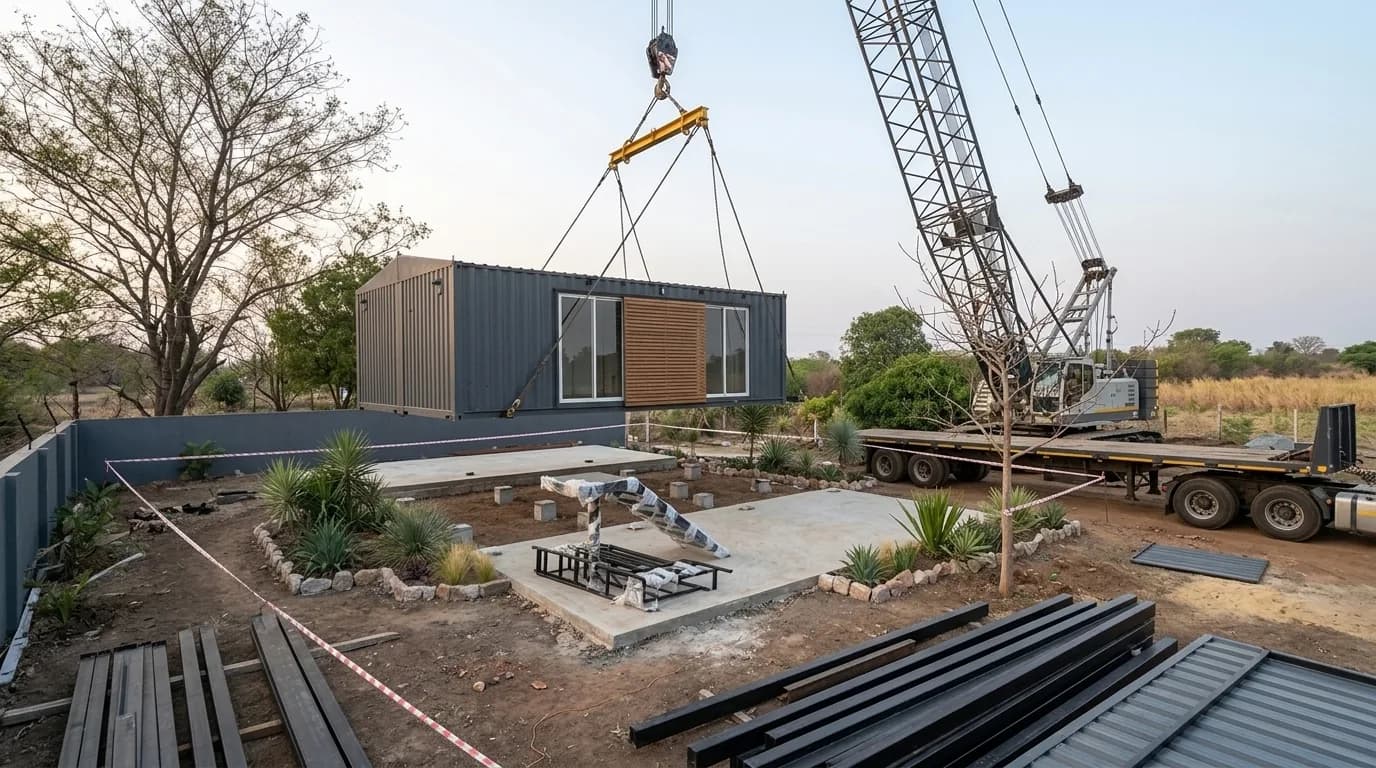
Being straight about the distance: we manufacture in Bangalore, so Coimbatore is a long run and transport is a real cost. It is quoted as its own line rather than folded into the unit price, and on something house-sized it is worth asking for that figure in the first conversation rather than the last. What matters more than the distance is the last stretch. Farm land is exactly where deliveries get stuck, so before anything is dispatched we work through four things. **The approach.** Whether a long vehicle can reach the plot or stops at the main road — width, overhanging branches, low cables, and what the track is like after rain. **The ground.** A loaded vehicle and a crane are both heavy. Soft or freshly ploughed ground is a problem, and the answer is sometimes a temporary path and sometimes a dry week. **The position.** Levelled, compacted, and chosen deliberately — for the view, for where water goes, and for which way the verandah faces at six in the evening. Moving it afterwards is possible but it is not free. **Crane access.** Whether one can reach and swing where the unit has to land, and whether it travels with us or is arranged locally. Send us a few photographs of the plot and the approach and we can usually tell you whether this is a straightforward delivery or one that wants the ground prepared first.
How Far the Service Area Extends
We deliver portable farmhouses to farm land in and around Coimbatore from our Bangalore facility. Delivery to locations beyond that is possible and is assessed case by case, against access to the plot and the feasibility of getting a house-sized unit onto it. That is deliberately not a list of place names. What decides whether we can deliver to you is the approach to your land and the ground at the far end of it, not which side of Coimbatore you are on — so the honest answer is to send us the location and a few photographs and let us tell you.
Delivery charges
| Delivery to | Charge incl. GST |
|---|---|
| Up to and including 50 km by road from our yard | ₹1,000 |
| Beyond 50 km, in Karnataka and Tamil Nadu | ₹18,000 |
| Andhra Pradesh, Telangana, Kerala and Puducherry | ₹28,000 |
| Elsewhere in India that we serve | ₹45,000 |
Charged at checkout when you buy online. Rates include GST and cover transport with standard loading at our factory. Unloading, positioning and installation at your site are optional, at ₹15,000 including GST, added only if you choose them.
In Karnataka and Tamil Nadu, the first two rates depend on the road distance to your exact address. It is not measured at checkout at present, so delivery to an address in Coimbatore is confirmed in a quotation.
Delivery is confirmed in a quotation instead when a PIN code cannot be verified, and for Lakshadweep and the Andaman and Nicobar Islands. On an order placed through a quotation, transportation is arranged and quoted based on the delivery location and site access. Full terms: Shipping & Delivery Policy.